When the crisis crosses sectors
The crisis your organisation plans for is increasingly a crisis it will not handle alone.
The scenario is no longer hypothetical
Danish public broadcaster DR ran a crisis exercise, Kriseøvelse: Hybridangreb på Danmark, built by preparedness researchers Rasmus Dahlberg and Lene Sandberg. The scenario: a hybrid attack on Denmark that darkens the whole of Zealand, with no stated horizon for when the power returns. A crisis team of eleven former decision-makers — from municipalities, the intelligence services, the food sector, healthcare, the Home Guard and the Defence — worked through ten constructed dilemmas.
Green Power Denmark sat on that team, representing the energy sector. Its technology director's assessment of the exercise was blunt: it reminded him of how Russia systematically targeted critical nodes in Ukraine's infrastructure, and while the simulation is extreme in a Danish context, every event in it is something we have seen on European soil in recent years.
Denmark's own threat assessments point the same way. The hybrid war is escalating — sabotage, destructive cyber attacks, drones against targets in Europe — and the Danish Security and Intelligence Service has publicly warned that Russia's espionage, influence operations and sabotage in Denmark could increase.
What this means for a port, a shipping company or a terminal operator: you are a critical node. Power, communications, booking systems, crane control, customs systems, vessel traffic services — the dependencies run in both directions. And when the event is large enough to activate multiple authorities at once, your response is no longer an internal matter.
The finding that matters: coordination is the gap
The energy sector's message from the exercise was not that sector preparedness is weak. It was that the cross-sector layer is where the value is being lost.
The sector reports thousands of cyber attacks deflected daily without consumers noticing, has proven security procedures, systematic monitoring of critical infrastructure and physical plant, and runs large-scale exercises with other authorities and the Defence on a regular basis. What it asked for was something else: a continuing forum — outside the television studio — where authorities, intelligence services and critical sectors can exchange experience and information, build a better feel for each other, and agree a clear division of responsibility.
Three requirements come out of that, and they are software requirements as much as they are policy ones:
A shared operational picture
Not a phone call, not an email thread, not a PDF circulated after the fact. Everyone looking at the same state of the incident.
Clear responsibility at the level of the individual action
Who owns this step, who has decided, who is waiting on whom.
Confidentiality by design
Information exchanged between authorities and critical sectors has to be shared with the right parties and no others, with the access controlled per participant.
What Honnimar does about it
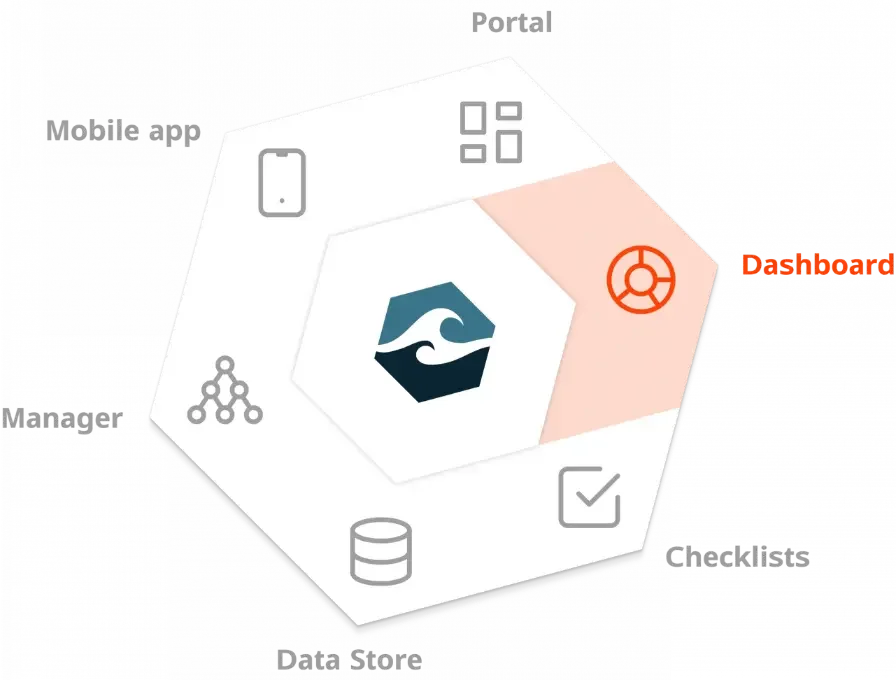
The dashboard is the shared picture. Ongoing events, critical information, assigned actions and a live action log in one place. Internally it can run as a command-centre display; externally the same view — or a filtered version of it — can be opened to the parties who need ongoing and immediate information.
Authority participation is built in, not bolted on. Police, fire service, environmental agencies and other officials can be brought into the incident on the same platform, with either the full overview or information tailored to their specific requirement. This is the mechanism the coordination gap calls for: the forum already exists in the platform, and the confidentiality is enforced by access control rather than by trust.
The log is the record of the division of responsibility. Every status change is timestamped and attributed. When the exercise is over, the question "who was responsible for that step and when did it change?" has a factual answer.
It works when the infrastructure does not. Offline capability means a responder without connectivity can still access manuals and protocols and still work through checklists; updates synchronise when the connection returns. In a total-blackout scenario, that is the difference between a plan and a document.
Prepare with the partners you will need
The Danish guidance is explicit: cultivate strategic partnerships and cross-cutting collaboration before the crisis, and check in with your local and regional authorities as part of your preventive effort. A preparedness forum has value because the relationships and the division of responsibility are established in calm conditions.
The practical version of that advice for a maritime organisation:
- Identify the authorities and agencies that would appear in your worst-case scenario — police, fire, environment, port authority, coast guard, municipality, customs.
- Give them access to your crisis view now, as part of an exercise, so that the first time they see the platform is not during a real incident.
- Run the exercise on the platform, evaluate using the logged timeline, and update the plan while the lessons are fresh.
- Keep the access in place. The forum you build is the capability you will actually use.
Read more about bringing authorities into the same platform, or the sovereignty position behind the access model.
Exercise with your authorities, not just about them.
We will set up a demonstration incident in Honnimar with an external authority view, so you can see exactly what the police or the fire service would see.
Book a demo